What changed this summerThis is a rundown of what has changed in the collar firmware since July, from v1.11.0 up to v1.18.1, which is current as of 30 August. Most of it came out of collars being in the field with people who wrote in when something was off, so if you sent me a note this summer, some of what’s below is probably yours. Three of the new features are experimental and I’ve put them in their own section so that’s clear. There are also two bugs from that stretch you should know about. Further down there’s hardware news, since CollarDT is going into production and the CollarID housing has a new revision, and a note about the mobile apps that matters if you use them. | |||||||||
| |||||||||
What landed | |||||||||
|
v1.13.0 · 19 Jul
Firmware updates over Bluetooth
You can now update the main processor and the MkII Mesh radio from the browser, over Bluetooth, without opening the enclosure or finding a USB‑C cable. The collar checks the whole image before switching to it, and if the check fails it keeps running what it had. On older MkII collars the radio still needs the cable, but the main processor updates wirelessly either way. There was a serious bug in the first version of this, which I get to below. | |||||||||
|
v1.15.0 · 4 Aug · LoRaWAN
Changing schedules on collars that are already out
For collars on a LoRaWAN network, schedules can be added and removed over the air now, up to five per collar. Mortality detection can be switched on and off remotely too. Schedule transfers used to trickle in over hours; the collar now speeds up its check-ins while a transfer is in progress, so it takes a few minutes instead. The collar also refuses any remote change that would silence it or overlap two windows, and the website tells you which rule it tripped on. | |||||||||
|
v1.13.0 · 19 Jul · LoRaWAN
Missed transmissions get re-sent on their own
LoRaWAN collars keep about a month of their own transmissions on the SD card. If the server sees a gap, it asks the collar for the missing packets and they come in over the next check-ins. This covers gateway outages as well: if a gateway is down for a day, the missing day fills in afterwards. You don’t have to do anything. | |||||||||
|
v1.18.0 / v1.18.1 · 29–30 Aug
8 kHz recording, and a sensitivity setting
Sample rate is now a per-schedule setting. 8 kHz halves what each recording takes on the card, so a card lasts about twice as long, and 16 kHz is still the default. There is also a microphone sensitivity setting (low, medium, high) for quiet or distant subjects, and the SD card estimate on the website follows whichever you pick. Also fixed in 1.18.0: a short burst of noise at the start of every recording, which turned out to have been there in every previous version. | |||||||||
I’m calling these three experimental. They work on the bench and they’re in the firmware now, but they haven’t had the field time the rest of this list has. If you use them, start with a few collars rather than the whole fleet, and tell me what you see. That feedback is what moves them out of this section. | |||||||||
|
v1.14.0 · 29 Jul · experimental
Mortality detection
The collar can watch for long periods with no movement and raise an alert. You set how many hours of stillness should trigger it and how often a flagged collar should beacon. Flagged collars show up on the live map and clear themselves when movement resumes. Step counts also started reporting real values in this release. | |||||||||
|
v1.18.1 · 30 Aug · experimental
Ultrasonic sample rates
On top of 8 and 16 kHz, a schedule can now record at 48, 96 or 192 kHz for high-frequency work like bats. Two warnings. 96 and 192 kHz fill a card very fast and use a lot more battery, so they’re for short planned sessions rather than all day. And the recording level at these rates is still being tuned. If you try them I’d like to hear how the recordings come out. | |||||||||
|
v1.11.0 · 9 Jul · experimental
Adaptive GPS sampling
The GPS fix interval can now follow how much the animal is moving, measured on the collar from the accelerometer. Resting stretches the interval out, sustained walking or running brings it in. The thresholds and the interval for each tier are set per schedule. There is also an option to transmit right after a fix instead of waiting for the timer. | |||||||||
| |||||||||
| |||||||||
Hardware and what’s coming | |||||||||
|
CollarDT · first production run
CollarDT is going into manufacturing
CollarDT is the detachment module. It releases a collar on a schedule, so you get the collar back without a recapture. It doesn’t need a CollarID to work: in standalone mode it goes on any collar and fires off its own clock. Paired with a CollarID it can also be triggered on command, but that needs newer CollarID hardware than what’s in the field today. We’re working on a hardware change for the next version of the CollarID that will support it; that’s part of the MkII Mesh work further down. The first manufacturing and assembly run is underway now with Seeed Studio, who we’re working with on production. The plan is about 30 devices by the end of September. Some of those go through lab testing here first, and the rest go to first deployments and customers. Pricing isn’t final while the tariff politics in D.C. get worked out. Right now 350 to 400 USD per device is our worst case, and we’re aiming to get it to 300 eventually. If you want to be in the first batch, reply and say so.
| |||||||||
|
CollarID MkII Mesh · in progress
The add-on link, and where it’s going
The link that CollarDT pairs over is the start of something bigger. The next iteration of the Mk II, which we’re calling MkII Mesh, turns the collar into a hub for other devices on the same animal. A detachment module first, other devices later. They pair over a short-range radio, check in with the collar on a schedule, and their status and commands ride along on the collar’s normal uplink, so one collar in coverage can look after everything attached to it. This was the core of my PhD thesis, and it has taken until now to get it out of the lab and into a product. We’re actively working on it. The pairing and remote-command pieces in v1.12.0 are the first parts, but it isn’t fully available yet, so I wouldn’t plan a deployment around it just yet. I’ll write more when there’s something to hand over. | |||||||||
|
CollarID · next housing revision
Removable wings and closer mounting holes
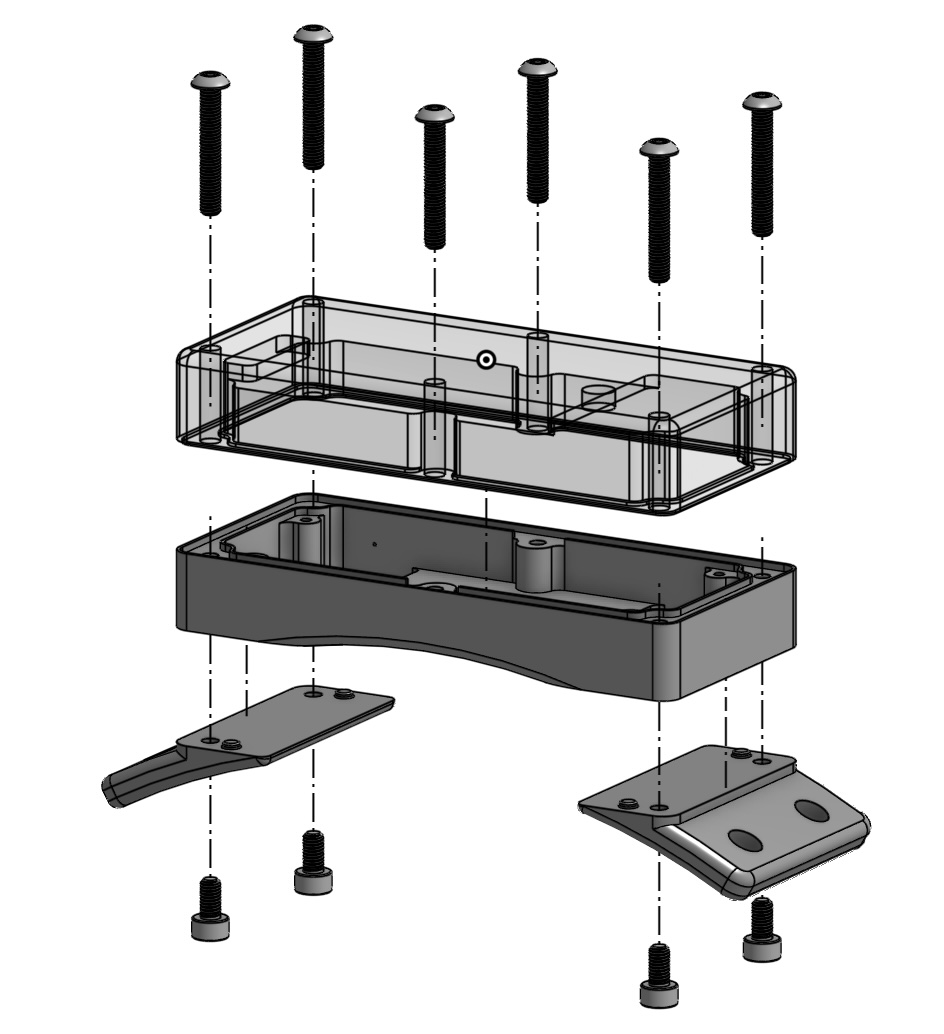
We’ve redesigned the CollarID housing for the next batch. Same shape and same weight, with two changes to how it mounts.
The wings that attach the device to a collar are now removable. You can mount the device flat without them, or make your own wings (3D printed, for example) to match a different collar curvature. And the mounting holes are now 20 mm apart instead of 30 mm, so it works with thinner collars and straps. New orders will ship with the new housing once the stock of the current version runs out. If you’d rather have the new one now, ask and we’ll try to make it work. | |||||||||
|
SD cards
Kioxia is still the recommendation
We still mainly recommend Kioxia SD cards. Other cards will work, but the power consumption estimates and the performance may vary with them. We’re actively testing and tuning the system for other manufacturers. Testing a card properly means running it in a lot of different settings, which takes a long time, so we’re getting to it as quickly as we can. Update, 22 Sep 2026: SanDisk Extreme and Extreme Pro have since been found to corrupt under recording and are not supported. Kioxia Exceria Plus remains the approved card. Update, 3 Oct 2026: SanDisk High Endurance 128 GB is now approved as an alternative, formatted with a 512 KB allocation unit size. See issue 02. | |||||||||
| |||||||||
|
| |||||||||
|
If your collars are on anything older than v1.18.1, this is a good time to update. The audio settings and most of the reliability work from this summer are in there, and the experimental features are off unless you turn them on.
Full release notes are at collarid.org/changelog. | |||||||||
|
Most of what’s in this email started as a message from someone. A collar that kept restarting, a card that filled up mid-deployment, someone who wanted to record bats. So if your collar does something strange, or you want it to do something it can’t, write to me. That’s how the list of what to work on next gets made. Patrick Patrick Chwalek, PhD · New Lens Labs |